
Scope-bound evidence records
Separate proof families. Separate claims.
Mechanism evidence, empirical evaluation evidence and operating evidence are presented as distinct records so each claim is tied to the proof that directly supports it. Institution-specific effectiveness remains a separate customer evidence track.
RUN-SCE-001 · Mechanism evidence
What the constructed scenario demonstrated.
Observable behaviour inside the declared synthetic scope.
MEANING
Mechanism evidence describes what the frozen demonstrator did in its declared synthetic scope.
NOT MEANING
Fraud truth, accuracy, predictive uplift, production performance or institutional validation.
RUN-SCE-001 · Reproducibility & evidence controls
Checks applied to the frozen evidence package.
Exact source labels are preserved without marketing paraphrase.
MEANING
Engineering checks describe reproducibility and evidence-control behaviour in the frozen package.
NOT MEANING
Full Core conformance, production readiness, security certification or regulatory approval.
Supporting empirical evidence — BAF-003
Supporting evidence under fixed review capacity.
AEGI BAF Context Representation Ablation Benchmark v0.1
A frozen comparison. A positive indication. An exact reproduction.
Using public synthetic BAF Variant V, AEGI ran a frozen, fixed-capacity comparison under the same learning procedure between an application-local control and a benchmark-specific context-enriched treatment. At the same Top-1% review capacity, the treatment surfaced 544 versus 494 fraud-labelled cases across 2,417 review slots—50 additional cases, or +20.7 per 1,000 reviews (95% bootstrap CI: +9.1 to +32.3). The result reproduced exactly.
EVALUATION DESIGN
Same learning procedure.
Same learning procedure.
Same review capacity.
Different risk representation.
The comparison isolates representation under a common frozen learning procedure and fixed Top-1% review capacity.
DATA ACCESS BOUNDARY
Source schema was inspected, while evaluation outcomes remained unseen before frozen execution. This was not an untouched blind holdout or an independently administered evaluation.
CONTROL · FIXED CAPACITY
TREATMENT · FIXED CAPACITY
Same capacity · +50 fraud-labelled cases surfaced
EVENT / PRIMARY RUN
EVT-BAF-003 · RUN-BAF-003REPRODUCTION RUN
RUN-BAF-003_REPRO · PASSExact stable-result identityPUBLIC RELEASE CLASSIFICATIONSupporting empirical evidence
- Frozen evaluation specifications and classification rule
- The same learning procedure and fixed review capacity
- A positive indication for the benchmark-specific context-enriched representation
- Exact declared reproduction
- Supporting empirical evidence within the public-synthetic scope
- A 20.7% fraud reduction or model-accuracy improvement
- Universal Shield or model superiority
- Production performance in customer environments, fraud-loss reduction or production readiness
- An untouched blind holdout
- Independent validation or independently administered evaluation
- Bank or GXS validation
- Feedzai endorsement
STATUS AND NEXT QUESTION
RUN-BAF-003 is complete and frozen.
No further model execution is required for this run. It supports the value of risk representation under fixed review capacity in this public-synthetic setting. Institution-specific value remains a question for institution-defined historical replay or non-customer-impacting shadow evaluation.
Explore the Controlled EvaluationOperating evidence — Operations v0.4.0
Deployed evaluation operations.
AEGI Operations is deployed for AEGI operating use and supports a structured, traceable case workflow for bounded evaluations—from intake and readiness through ownership, next actions, saved drafts, interaction history and handoff. The accepted release identity remains separate from the current operating state.
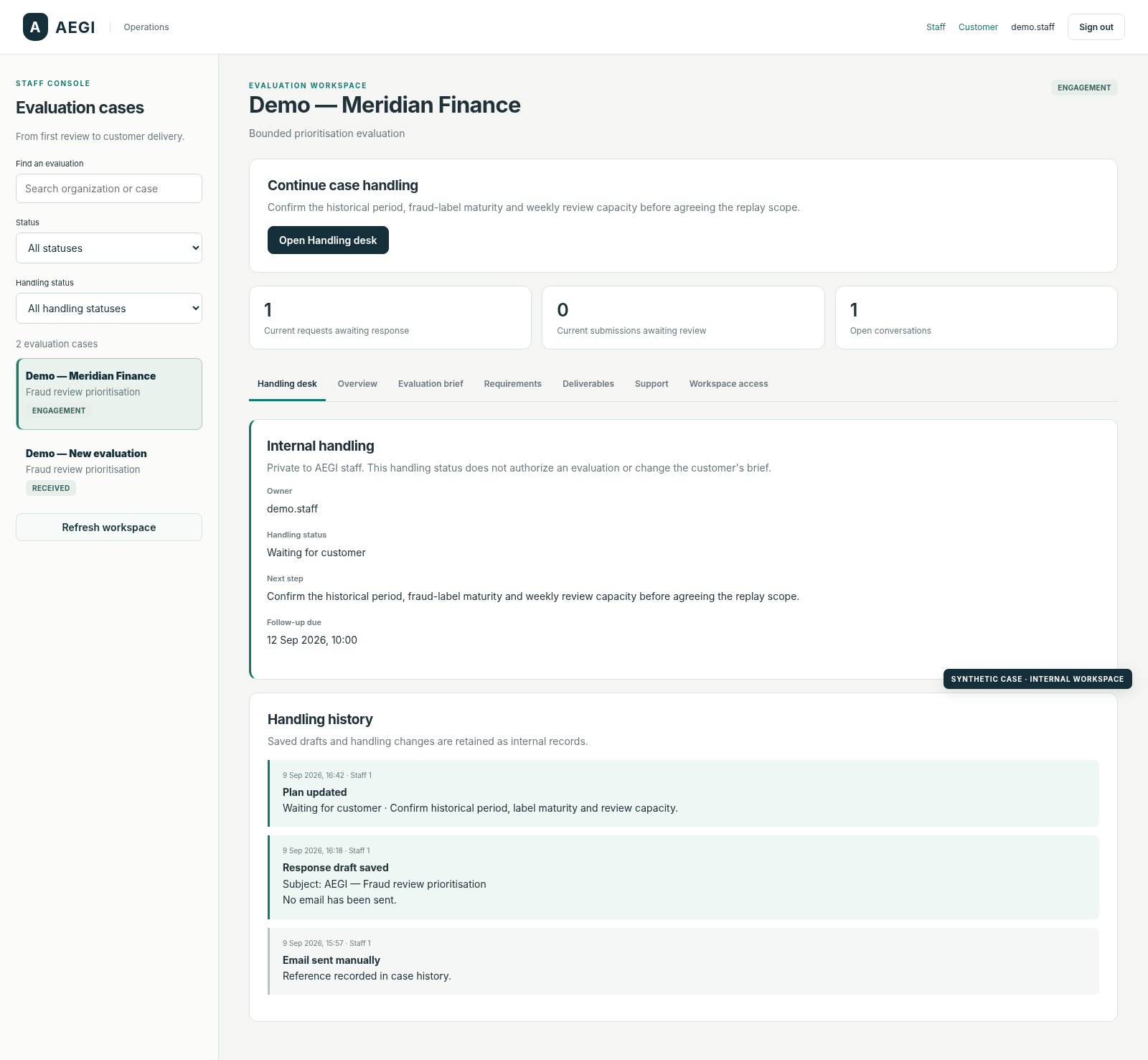
Technical release boundary
Current operating state: AEGI Operations is deployed for AEGI's own operating use. The accepted v0.4.0 release record does not, by itself, establish customer-host deployment. Institution-specific identity and access controls, external messaging, ingress/hosting configuration and production integration are accepted separately for each environment.
Evidence maturity separation
Progress in one track does not advance every track.
Public evidence, product maturity and customer validation remain separate.
Bounded public evidence.
- RUN-SCE-001 mechanism and evidence controls in its frozen synthetic scope
- RUN-BAF-003 supporting empirical evidence in its frozen public-synthetic scope
- Shared Risk Context and Mode Guard behaviours only where directly supported
- AEGI Operations v0.4.0 accepted internal release baseline, with current operating state deployed for AEGI use; public demonstration uses synthetic cases
Controlled evaluation methods.
- Controlled replay subject to approved workflow and evidence readiness
- Governed candidate evaluation within bounded scope
- Execution posture defined for the selected evaluation profile
Customer-environment evidence.
- Customer-defined historical replay and comparison
- Customer security, privacy and residual-risk review
- Decision on any later shadow or production stage
Progress in the Evidence track does not automatically advance Product Maturity or Customer Validation.
CORE ASSURANCE CONCEPT
A broader evidence-assurance discipline.
Core is described by architectural consequence and review value.
FROZEN DEMONSTRATOR EVIDENCE
Selected mechanisms and controls.
RUN-SCE-001 does not establish full Core conformance or production readiness.
NEXT EVIDENCE STEP
Move from public evidence to an institution-defined question.
A Controlled Evaluation applies the relevant workflow, baseline, approved inputs and decision measures in the customer context.
Explore Controlled Evaluation